
AI B-Roll Suggestions From Your Own Footage
Most editors hunt stock sites for B-roll they already own. Here is how understanding-based AI finds coverage inside your own footage by matching what is said to what was shot.
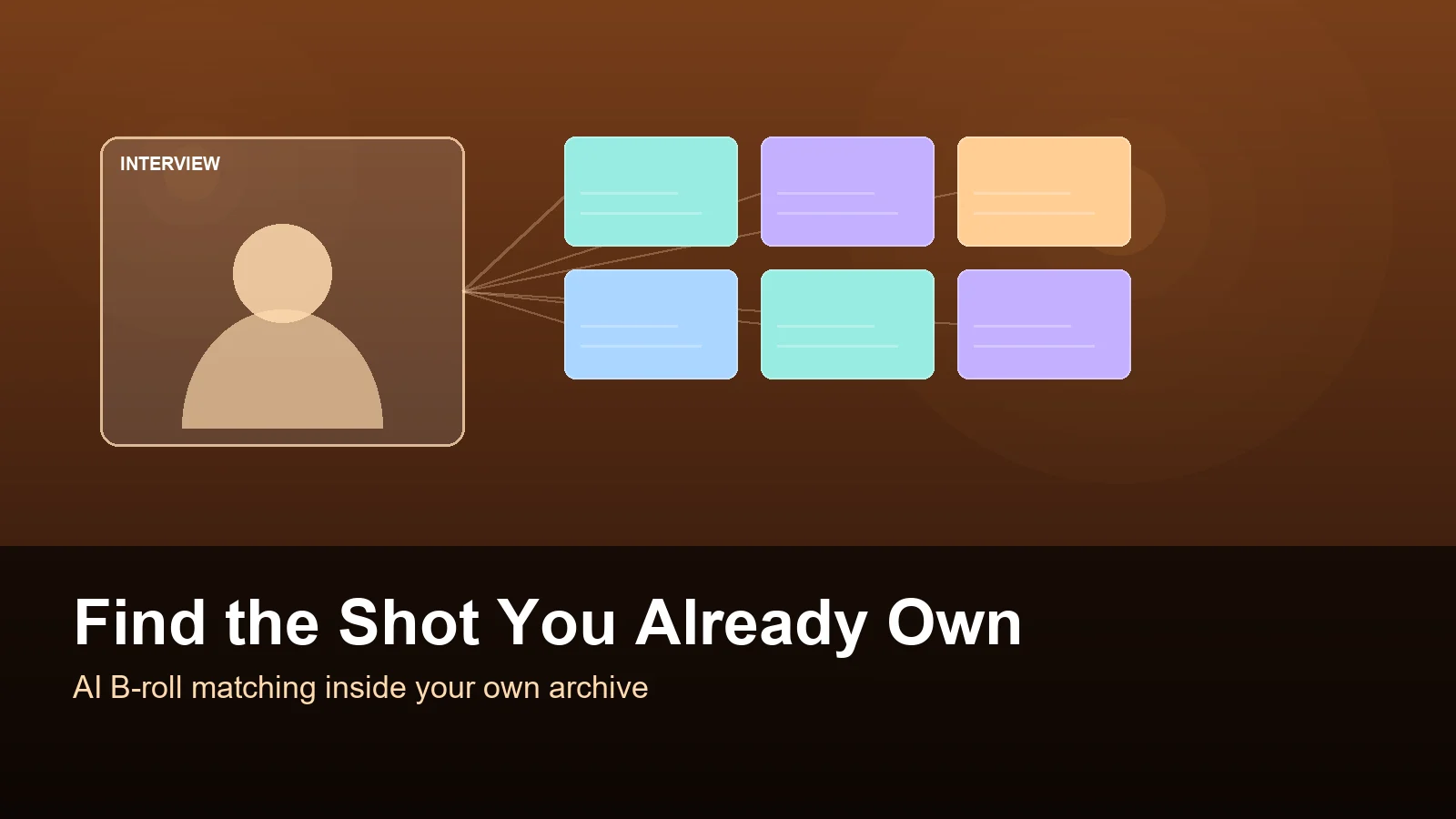
Every editor has the same quiet problem: a two minute segment where someone talks over a single static shot, and somewhere on the drive there is exactly the footage that would fix it. The bottleneck is not the footage, it is finding it. Searching by filename and thumbnail means you only ever find the clips you already remember, which is why the same six shots show up in every video. AI B-roll suggestion is an attempt to break that loop by searching the way an editor thinks: by meaning, not by filename.
1. Why your best footage never gets used
Footage becomes invisible for boring reasons. File names are camera generated, so the clip you need is called A7S0321 and looks identical to the forty around it. Thumbnails show the first frame, which is usually a hand in front of the lens or a slate. Sorting happens by date, and memory is organized by story, so the two indexes never match. The result is a strong bias toward whatever you happened to review last: familiar clips get reused, the rest compresses into an undifferentiated pile. On a long project that pile becomes a real cost, because the difference between a decent video and a good one is often coverage you already paid to shoot.
- Camera generated names carry no meaning.
- Thumbnails show the least useful frame of a clip.
- Date ordering and story ordering are different shapes.
2. What a B-roll suggestion actually is
A useful suggestion is not a random pretty shot. It is a match between a specific line of narration and a specific moment in the footage, where the image illustrates, complicates, or grounds what is being said. That means the system needs a description of the speech, a description of the footage, and a way to compare them. The comparison is where most tools cheat: they match keywords, so a line about a market gets the clip tagged market, even if the clip is a wide shot of an empty street that reads as loneliness. Meaningful matching needs to know what a shot conveys, not just what object appears in it.
- Speech side: what claim is this line making.
- Footage side: what does this shot show and feel like.
- Matching: does the image support, contrast, or literalize the line.
3. Building the footage index
The index is the unglamorous half of the feature. Each clip gets split into scenes, because a ten minute file usually contains several unrelated moments. Every scene gets a description built from sampled frames, detected objects, and any people the system can recognize and track. Speech in the footage is transcribed separately, so a clip where someone says the name of a place is findable by that word even if the image is generic. Motion and shot scale get recorded too, because a static wide shot and a handheld close-up are not interchangeable even when they show the same subject.
- Scene splitting turns one file into several searchable moments.
- Visual descriptions capture subject, framing, motion, and mood.
- In-clip speech adds a second searchable signal.
4. Matching a line to a shot
With both sides described, matching becomes a ranking problem. The strongest candidates are literal: someone mentions a river, there is a river. The second tier is functional: someone describes feeling lost, and a wide empty road does the job better than a map graphic. The third is contrast, where the image argues with the line, which is a deliberate editorial choice and usually too clever to automate safely. A good system surfaces literal and functional matches and leaves contrast to you. It should also surface near misses, because the second best clip is often the one that works once you see it.
- Prioritize literal matches for clarity, functional matches for tone.
- Leave ironic or contrasting matches to human choice.
- Show several candidates rather than one confident answer.
5. Adding suggestions without wrecking the cut
The failure mode of automated B-roll is coverage that fights the audio: a new shot every two seconds, none of them held long enough to register. Treat suggestions as an inbox, not an instruction. Start with the segments where talking runs longest over a single image, place one strong shot there, and leave the rest alone. Keep the rule that a B-roll shot should either advance the argument or give the eye a rest, not both at once. And watch the joins: cutting from a wide interview shot to a handheld clip with different color temperature reads as an accident unless you correct it.
- Fill the longest visual droughts first.
- One shot per idea beats a montage per sentence.
- Match color and motion at the joins or the cut looks accidental.
6. Making your archive searchable for next time
The compounding benefit arrives on the second project. If footage is indexed once and the index persists, the archive becomes queryable: find every shot of a kitchen, every clip where someone laughs, every exterior at golden hour. That changes how you shoot, because you stop over-recording safety coverage and start trusting that yesterday footage is reachable today. The discipline required is modest: import promptly, let the index run in the background, and keep naming conventions for projects rather than for clips. The clips themselves no longer need meaningful names once meaning is attached to them automatically.
- Index once, query forever.
- Import promptly so the index stays current.
- Name projects, not individual clips.
FAQ
Can AI find B-roll in footage that has no metadata?
Yes, and that is the point. The index is built from the pixels and the audio, not from file names or tags, so an archive of camera named files with no metadata at all becomes searchable once it has been processed. Metadata helps when it exists, but it is no longer a requirement.
Does this replace stock footage?
It reduces the need, not the use. Stock is still better for things you never shot, like a specific city skyline or a medical procedure. What changes is the default: before paying for a clip, you check whether your own archive already has something more specific and better lit, which it often does.
How accurate are the suggestions?
Literal matches are reliable, functional matches are usually good, and tonal or ironic matches should be treated as ideas rather than answers. The practical measure is how often the first three candidates contain something you would actually use, which is a much better bar than whether the top result is perfect.
Will automatic B-roll make my video look generic?
Only if you accept every suggestion. Coverage that illustrates each sentence literally is the fastest way to look like everyone else. Use suggestions for the stretches where the image has gone stale, and keep the shots where you deliberately hold on a face for eight seconds because the silence is doing the work.